
When following a ketogenic diet, fat is not simply an optional addition, it takes center stage as the body’s primary source of energy. Carbohydrate intake is reduced enough to support ketosis, while fat provides most of the calories needed for daily activities, brain function, overall health, and growth in children.
And protein? We haven’t forgotten it but it simply plays a supporting rather than starring role. Adequate protein is carefully recommended to support muscle health, tissue repair, and many other essential functions. But more is not necessarily better. Contrary to a common misconception, a therapeutic ketogenic diet is not a high-protein diet. It is a high-fat, adequate-protein, low-carbohydrate diet: enough protein to meet the body’s needs without overdoing it.
That leaves fat carrying most of the energy load and getting enough of it can be challenging. Food preferences, gastrointestinal tolerance, cost, food access, and cultural eating patterns all influence which fats are realistic for an individual or family.
That is why at AKT we often think about fat in three practical steps:
Get enough fat to meet your ketogenic diet goals.
Include a variety of fats whenever possible.
Choose less-processed sources when they are available, affordable, and well tolerated.
The priority is creating a diet that someone can follow. A theoretically “perfect” combination of fats is not helpful if the meals are unaffordable, poorly tolerated, or consistently refused.
Understanding the Different Types of Fat
Foods rarely contain just one type of fat, so they are grouped according to their primary fat source. The primary categories are saturated, monounsaturated, and polyunsaturated fats. Medium-chain triglycerides, or MCTs, are generally grouped with saturated fats but have unique properties that make them particularly relevant to ketogenic therapy.
Let’s Get a Little Nerdy About Fat
Every fat is built from a chain of carbon atoms. When you see a name such as C8, C10, or C12, the “C” stands for carbon and the number tells you the length of that chain. Fats are also grouped by the number of double bonds they contain: saturated fats have none, monounsaturated fats have one, and polyunsaturated fats have two or more. These differences may seem small, but they influence how a fat behaves and how the body processes and uses it.
Saturated Fats
Saturated fats are usually solid or semi-solid at room temperature, although there are exceptions.
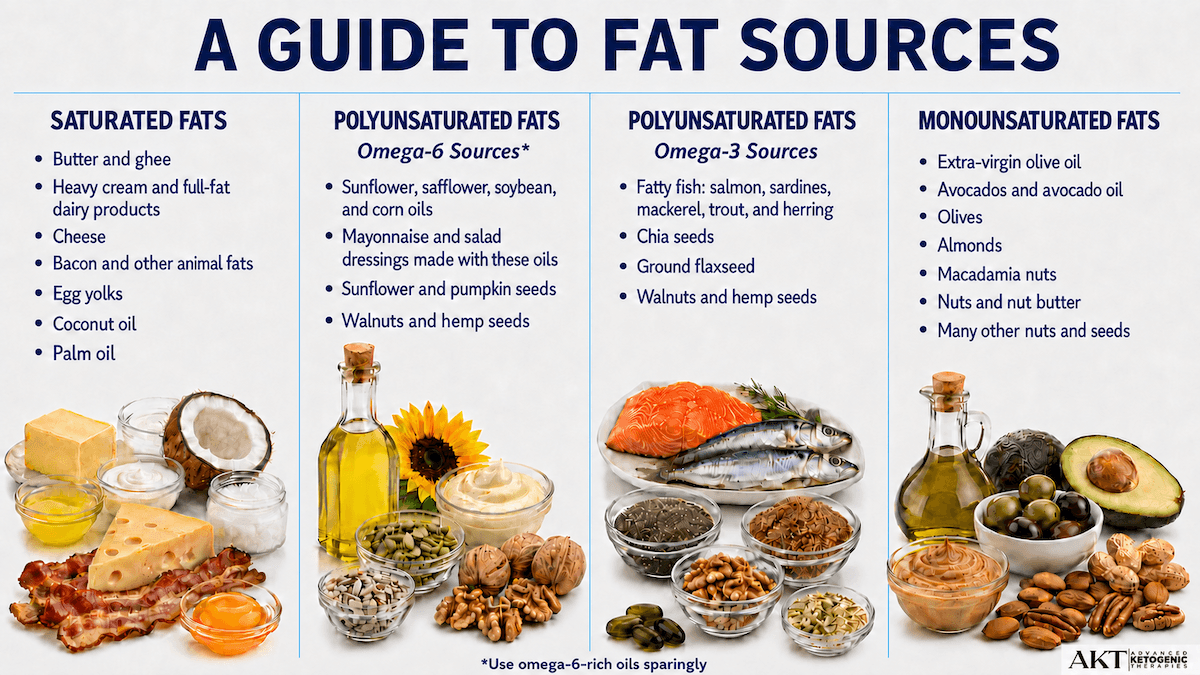
Common sources include butter and ghee, heavy cream and full-fat dairy products, cheese, bacon and other animal fats, egg yolks, coconut oil, and palm oil.
These foods can be practical ways to increase fat and calories, particularly for someone who enjoys creamy foods or needs a large amount of fat in a relatively small volume. Saturated fats also tend to be more stable during cooking than many polyunsaturated fats.
Monounsaturated Fats
Monounsaturated fats are found in many plant-based foods and are a valuable part of a varied ketogenic diet. Sources include olive oil, avocados and oil, olives, and most nuts/seeds.
Monounsaturated fats are an excellent way to diversify a ketogenic diet. Olive oil can be added to vegetables, dips, soups, sauces, or finished meals. Avocado provides fat along with fiber, potassium, and other nutrients. Nuts and nut butters can supply fat, protein, vitamins, and minerals, although their carbohydrate content must be considered in a structured ketogenic diet.
Polyunsaturated Fats
Polyunsaturated fats include the essential omega-6 and omega-3 fatty acids. They are described as “essential” because the body cannot make them and must obtain them through food. While we need both, they do not always require the same amount of planning. Omega-6 fats are widely available in our food supply, while omega-3-rich foods often need to be included more intentionally.
Omega-6 sources include sunflower, safflower, soybean, and corn oils as well as any mayonnaise and salad dressings made with these oils. Sunflower seeds, pumpkin seeds, and walnuts also fit into this category. These fats are also commonly found in packaged foods and restaurant meals, so most people do not need to make a special effort to add more omega-6 to their diets.
Omega-3 sources include fatty fish such as salmon, sardines, mackerel, trout, and herring, as well as chia seeds, flaxseed, walnuts, and hemp seeds. Different foods provide different types of omega-3s. Chia, flax, walnuts, and hemp seeds primarily provide alpha-linolenic acid, or ALA. Fatty fish provides eicosapentaenoic acid (EPA) and docosahexaenoic acid (DHA), which can be used more directly by the body. Walnuts and hemp seeds appear in both lists because they contain both omega-6 and omega-3 fatty acids.
Omega-6 and Omega-3: Focus on Balance, Not Perfection
There is plenty of discussion about the “ideal” omega-6-to-omega-3 ratio, but no single target has been established and this is not a math problem worth obsessing over. A more practical approach is to intentionally include omega-3-rich foods, such as fatty fish, chia seeds, ground flaxseed, and walnuts, throughout the week. Because omega-6 is already widely available, and some omega-3 sources, such as walnuts, provide both, most people can meet their omega-6 needs without making a special effort.
Rather than actively seeking additional omega-6 sources, look for everyday opportunities to create a better balance. When possible, limit highly processed “keto” snacks and convenience foods, as many rely heavily on omega-6-rich seed oils. For routine cooking and meal preparation, choose oils higher in monounsaturated fat, such as extra-virgin olive oil and avocado oil, as well as saturated fats such as butter or ghee, more often than oils composed primarily of omega-6 polyunsaturated fats.
Keep in mind that does not mean every plant or seed oil should be labeled entirely “good” or “bad.” For most people following ketogenic therapy, always consider the full dietary pattern.
How often is the oil eaten?
What nutrients does the food provide?
What other options are realistic?
Is the diet varied?
Does the diet rely heavily on highly processed foods and oils?
These questions are usually more helpful than focusing on or fearing a single source of fat.
What Makes MCTs Different?
Medium-chain triglycerides are saturated fats made with shorter fatty-acid chains. The “C” number tells us how many carbon atoms are in that chain.
The MCTs most often discussed in ketogenic therapy are:
C8: Caprylic acid
C10: Capric acid
C12: Lauric acid
C8 and C10 are absorbed and transported differently from most longer-chain fats. They travel quickly to the liver, where they are readily used for energy and converted into ketones. C8 generally produces the strongest and fastest ketone response. C10 is also ketogenic, although usually less so than C8, and is being studied for additional neurologic effects beyond ketone production.
C12 is more complicated. It is chemically classified as a medium-chain fatty acid, but the body processes much of it more like a long-chain fat. As a result, C12 does not typically generate ketones as efficiently as C8 or C10.
MCT oil products generally contain C8, C10, or a combination of the two. Some products are marketed as “C8 oil” because of C8’s stronger ketogenic effect. MCT oil can be helpful, but more is not always better.
Increasing it too quickly can cause cramping, nausea, loose stools, or diarrhea. It should generally be introduced gradually and divided throughout the day.
Is Coconut Oil the Same as MCT Oil?
No. Coconut oil contains several saturated fats, with C12 making up close to half of its content. It contains much smaller amounts of C8 and C10—approximately 6% to 8% of each.
Coconut oil can absolutely be part of a ketogenic diet, but it should not be expected to produce the same ketone response as a concentrated C8 or C8/C10 MCT oil. Coconut oil is better viewed as a versatile food-based fat with some medium-chain fatty acids rather than as a direct replacement for therapeutic MCT oil.
What Does “Less Processed” Look Like?
Choosing less-processed fats does not mean every food must be homemade or that packaged products are automatically unhealthy. It means building the diet around recognizable, nutrient-rich foods when doing so is practical.
Examples might include:
Avocado instead of relying only on bottled oil
Olives, nuts, or seeds as part of a meal
Salmon or sardines as sources of both fat and protein
Olive oil, butter, or cream used in home-prepared foods
Nut or seed butter with a short ingredient list
Convenience products, mayonnaise, dressings, and packaged ketogenic foods may still play an important role. Sometimes they are exactly what makes adequate intake and consistent ketosis possible.
Bringing It All Together: A Day of Diverse Fats
You do not need to include every type of fat in every meal. Instead, look for opportunities to incorporate a variety of fats throughout the day. For example:
Breakfast: Eggs cooked in butter with avocado
Lunch: Chicken salad made with mayonnaise, served with olives and walnuts
Snack: Full-fat Greek yogurt with chia seeds and MCT oil
Dinner: Salmon with a non-starchy vegetable dressed in extra-virgin olive oil
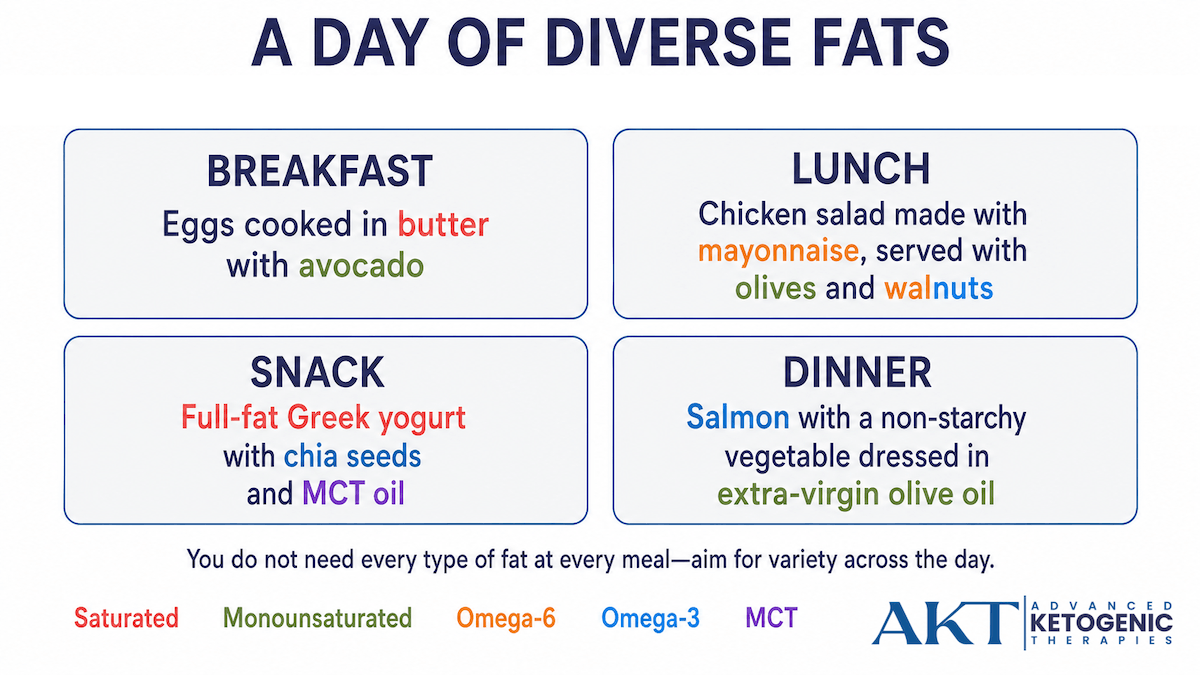
This sample day includes saturated fats from butter, eggs, and dairy; monounsaturated fats from avocado, olives, and olive oil; omega-6 fats from mayonnaise and walnuts; omega-3 fats from walnuts, chia seeds, and salmon; and medium-chain fats from MCT oil.
The goal is not perfection. First, meet the prescribed fat targets in a way that is sustainable. Next, gradually diversify the fats used across meals. Finally, choose minimally processed options that fit your individual medical needs, preferences, tolerance, budget, and access.
A well-designed ketogenic diet is not built around one “best” fat. It brings together a thoughtful combination of fats to support ketosis, adequate nutrition, enjoyment, and long-term success.
