
New research explores how combining education with firsthand experience may improve healthcare professionals' confidence in discussing ketogenic metabolic therapy (KMT) for mental health.
Understanding the science behind KMT is one thing. Understanding what it actually takes to follow the diet, from planning meals to navigating everyday challenges, is another.
For Denise Potter, RDN, CDCES, owner of Advanced Ketogenic Therapies (AKT), helping healthcare professionals bridge that gap has long been a priority.
"What initially excited me about Live It Launch It was that it put legs to something I already believed in."
Denise has encouraged dietitians and other healthcare professionals to try KMT firsthand to better understand the practical challenges their patients face. The Live It, Launch It (LI-LI) pilot study offered an opportunity to explore that concept through a structured program combining education with a four-week ketogenic experience.
Led by researchers at the University of Maryland School of Medicine and published in Frontiers in Psychiatry, the study examined whether this approach could strengthen healthcare professionals' perceived competence and confidence in discussing KMT for mental health care.
Denise served as a co-author of the publication, while the AKT clinical team and Ketogenic Therapeutics Mastery contributed education and practical support throughout the program.
For the AKT clinicians involved, the experience offered valuable insights into what happens when healthcare professionals move beyond learning about KMT and begin navigating it themselves.
What Was the Live It, Launch It Program?
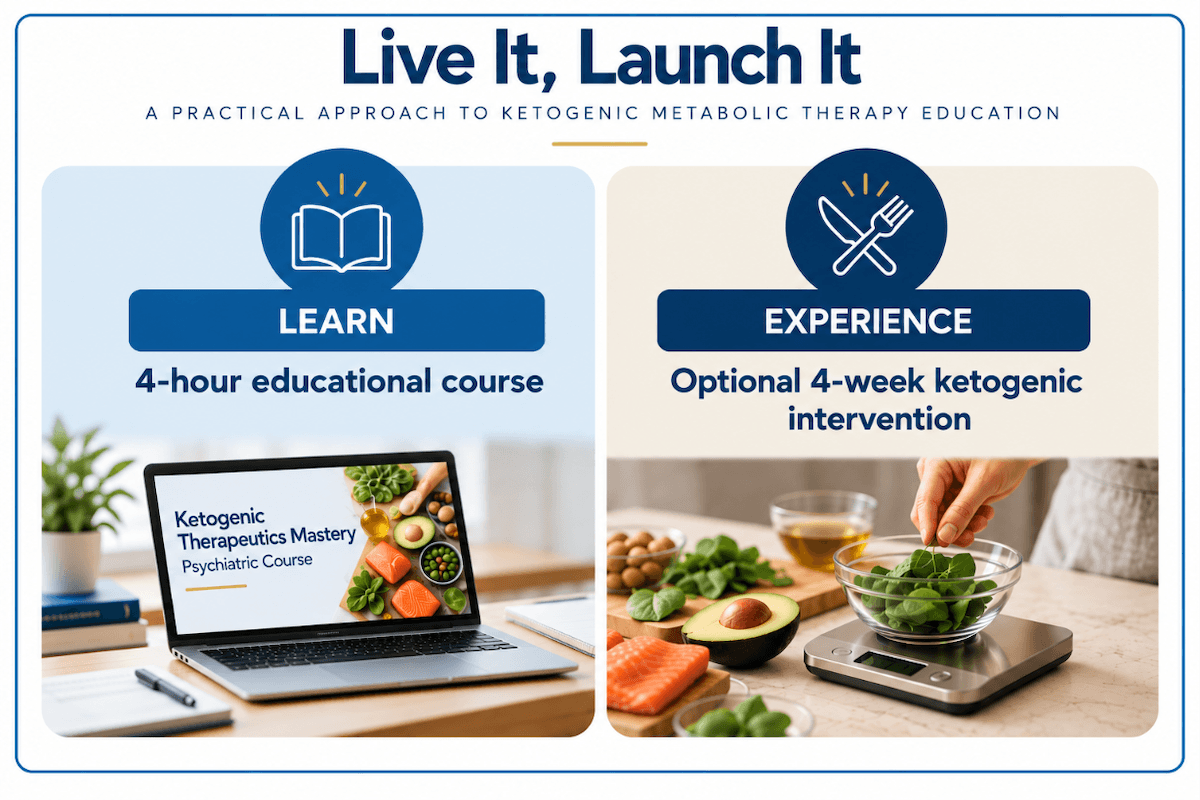
Live It, Launch It was a pilot training program designed to help healthcare professionals better understand KMT and its potential applications in mental health care.
The program combined two components:
Education: A four-hour online course covering the science of KMT, therapeutic approaches, nutritional considerations, monitoring, and practical implementation. The Ketogenic Therapeutics Mastery Psychiatry Course provided the educational foundation.
Firsthand experience: Following the educational course, participants could choose to complete a four-week ketogenic dietary intervention, putting what they learned into practice.
The AKT clinical team provided nutrition guidance and support during the experiential phase, helping participants navigate meal planning, macronutrient targets, dietary adjustments, and everyday challenges.
What Was It Like to Experience KMT Firsthand?
For the AKT dietitians supporting the project, one of the most valuable aspects was watching healthcare professionals navigate many of the same practical challenges patients encounter.
Although participants had clinical backgrounds, they still needed to learn how to translate ketogenic principles into everyday food choices.
Denise noted that many participants had familiar questions about calculating macronutrients, understanding ketogenic ratios, and balancing their nutritional targets from meal to meal.
"There's so much to learn just by doing it: figuring out how to add fat, managing social events, making a keto recipe, perhaps weighing some food items, and noticing how you feel when you're in ketosis," Denise explained.
Navigating Everyday Challenges
Lenycia Neri, PhD, MSc, RDN, an AKT dietitian who supported the project, observed two particularly common challenges:
Social and workplace situations: Navigating shared meals, hospital or clinic cafeterias, and gatherings where higher-carbohydrate foods were often the default.
Meal preparation and food variety: Learning to build satisfying higher-fat meals, incorporate appropriate fat sources, and maintain variety without relying on familiar staples such as bread, pasta, and grains.
A Different Kind of Participant
The AKT team also noticed that these healthcare professionals approached the experience with considerable motivation and a strong understanding of the underlying science.
Lenycia observed that participants generally grasped the physiological concepts quickly and were diligent about tracking their intake and following the protocol.
Denise similarly appreciated working with practitioners who had volunteered because of their professional interest in KMT and its potential role in patient care.
However, she also recognized an important distinction: These participants were generally approaching the diet from a professional learning perspective, rather than simultaneously managing a psychiatric condition.
That difference matters when considering how their experience compares with that of patients who may be navigating additional medical, psychological, or practical challenges.
Still, the project gave participants an opportunity to appreciate something that scientific education alone cannot fully convey: the day-to-day experience of following a ketogenic diet.
What Did the Researchers Find?
The pilot study included 40 healthcare professionals, including psychiatrists, psychiatric pharmacists, psychologists, therapists, nurse practitioners, physician assistants, and other clinicians.
All 40 completed the educational component. Of those, 25 began the optional ketogenic dietary intervention, and 21 completed the four-week experience.
Researchers evaluated changes in participants' self-reported competence related to KMT and their perceived confidence in supporting shared decision-making with patients.
Greater Perceived Competence With KMT
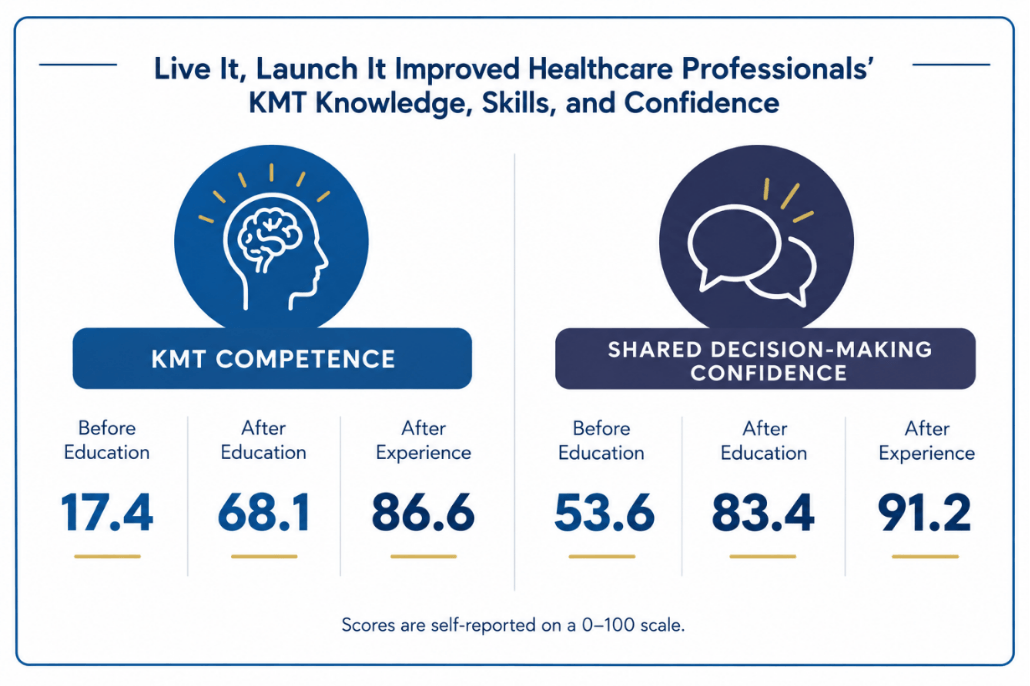
Participants rated their perceived competence with KMT on a scale from 0 to 100.
Average scores increased from:
17.4 before education
68.1 after the educational course
86.6 after the experiential ketogenic phase
These improvements were statistically significant, suggesting that structured education was associated with substantial gains in perceived competence, with additional improvements observed following firsthand experience.
Importantly, these scores reflect participants' self-reported perceptions rather than an objective assessment of clinical skills.
Greater Confidence in Shared Decision-Making
Researchers also evaluated how confident participants felt engaging patients in shared decision-making, an important process that involves discussing treatment options, potential benefits, risks, and individual preferences.
Average scores increased from:
53.6 before education
83.4 after the educational course
91.2 after the experiential phase
Together, these findings suggest that combining education with practical experience may help healthcare professionals feel better prepared to discuss KMT as a potential therapeutic option.
How Can Firsthand Experience Influence Patient Care?
For the AKT clinical team, one of the most meaningful aspects of Live It, Launch It was the opportunity for healthcare professionals to better understand what they may eventually ask their patients to do.
Lindsay Krupp RDN, an AKT dietitian involved in the project, emphasized:
"I think experiencing a ketogenic diet firsthand gives you a level of understanding for how difficult it is and what you might experience as you get into ketosis. It allows you to have more empathy for the people you are recommending the diet for and it also gives you unique insights into the day to day struggles people face (like eating out, making spontaneous food decisions, keto adaptation/keto flu, etc)."
Danielle Eller MS, RDN, CSP, CDN, another AKT dietitian who participated in the project, shared a similar perspective:
"Having personal experience allows them to explain the process in greater detail, better assess which patients are appropriate candidates, and provide practical tips, strategies, and food ideas to help patients adhere to the diet long-term."
For Lenycia, this perspective became even more personal. In addition to supporting participants, she completed her own two-week ketogenic trial.
"I also gave myself a 2-week trial of the diet, so I can say that firsthand experience transforms clinical empathy into actionable guidance."
These experiences may help clinicians have more realistic conversations with patients about dietary expectations, potential challenges, and the support needed for successful implementation.
This is particularly relevant in mental health care, where treatment decisions must account for an individual's medical needs, daily routines, preferences, and ability to manage a structured nutrition intervention.
It also reinforces the importance of collaboration with Registered Dietitians and other healthcare professionals who have specialized expertise in therapeutic ketogenic diets.
What Are the Study's Limitations?
Although the findings are encouraging, Live It, Launch It was a small pilot study without a randomized control group.
Its primary outcomes were based on participants' self-reported perceptions rather than objective measures of clinical competence. Participation in the four-week ketogenic intervention was also optional, meaning those who chose to participate may have been particularly motivated or interested in KMT.
Additionally, the study did not establish whether increased confidence translated into changes in clinical practice or improved patient outcomes.
Future research will be needed to determine whether similar educational and experiential programs lead to more informed clinical discussions, appropriate referrals, and effective implementation of KMT in patient care.
Looking Ahead: Bringing Education and Experience Together
For Emily Samuels, MS, RDN, CSP, LD, one of the AKT clinicians who participated in the project, a key takeaway from Live It, Launch It was the opportunity to address the underutilization of KMT across several medical conditions. By increasing awareness and understanding of KMT among clinicians, there is an opportunity to reach more of the people who need it most.
For Denise Potter and the entire AKT clinical team, Live It, Launch It reinforced the value of giving healthcare professionals an opportunity to experience the therapy they may one day recommend to patients.
"We’ve already started conversations and planning for Live It Launch It 2 in collaboration with Dr. Deanna Kelly and Sydney Murray at the University of Maryland. We’re excited about the possibility of expanding this initiative on a much larger scale and giving even more practitioners that firsthand experience," Denise shared.
While further research is needed to determine whether this type of training translates into improved clinical practice and patient outcomes, Live It, Launch It offers an encouraging starting point for exploring how education and personal experience can work together to support more informed, patient-centered care.
Explore the Research and Learn More
Read the full published research article:
Read the University of Maryland School of Medicine press release:
Watch the video:
Learn more about Live It, Launch It on YouTube
For healthcare professionals interested in KMT education:
Explore the Ketogenic Therapeutics Mastery Psychiatry Course.
