
When Jim began ketogenic metabolic therapy in January 2019, after being diagnosed with brain cancer, he was ready to take an active role in his health. He approached the process with remarkable commitment including tracking his ketones and glucose, noticing how different foods affected him, and sharing what he learned along the way.
But Jim did not need a one-time plan that would be handed to him and never revisited. As his health, medications, activity, and ketone levels changed, his plan needed to change with him.
“That was the beauty of having AKT—I could reach out, share what wasn’t working, and we could change things if they needed to be changed.”
That regular back-and-forth became one of the most valuable parts of the process. Together, his plan moved from the big-picture foundations of ketogenic metabolic therapy to the everyday details that made it sustainable.
Jim’s experience reflects a core part of how we work at AKT. Creating a plan isn’t the end of the process, it’s just the beginning.
Care Built Around the Individual
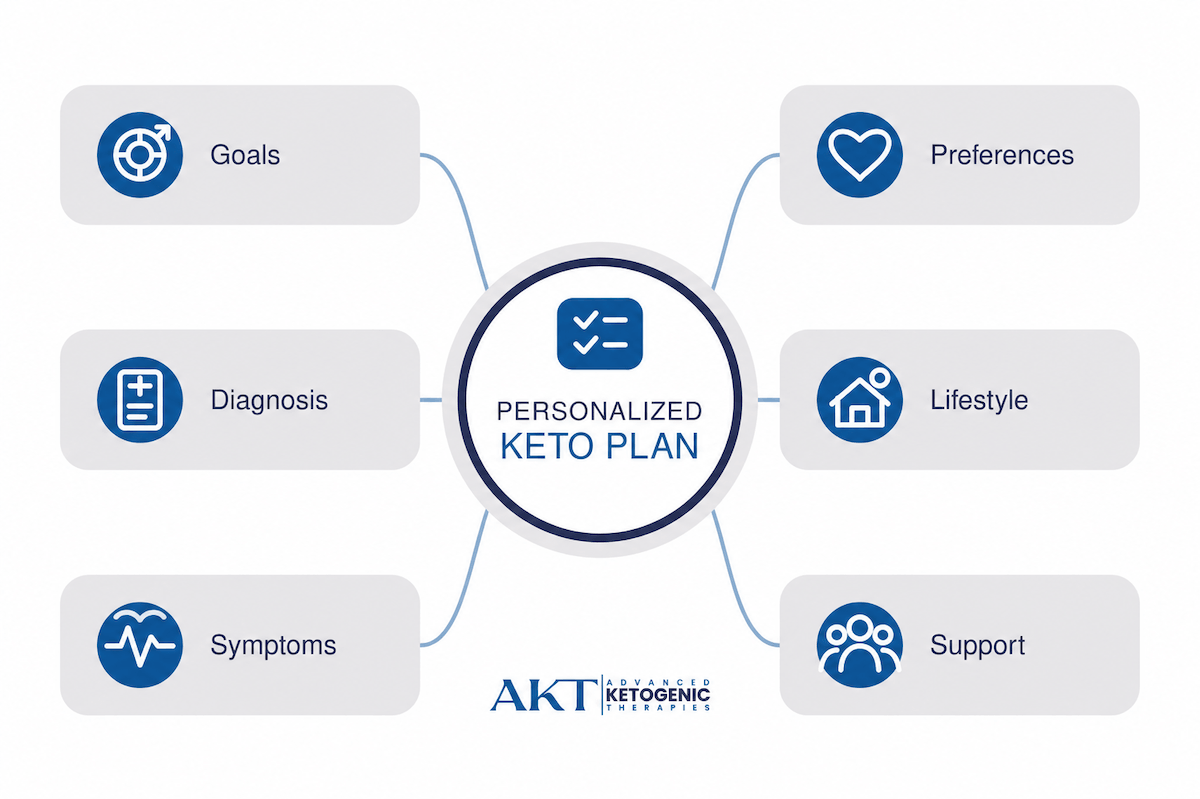
Every person comes to AKT with a different diagnosis, medical history, lifestyle, support system, and set of goals. Everyone is trying to understand how keto can fit into work, school, travel, family meals, or an already demanding schedule.
That is why the first step is listening.
Calories, ketogenic ratios, meals, and monitoring recommendations are guided by clinical goals, anthropometrics, diagnosis, symptoms, and treatment. But a plan also needs to reflect food preferences, tolerance, routines, available support, and what someone can realistically sustain.
As one client shared:
“My AKT dietitian is a great, attentive listener and took the information from our conversations to personalize a plan for me and my dietary needs. I also appreciated that she followed up each of our calls with detailed call notes and next steps.”
Personalization is not limited to the first set of recommendations. It continues as we learn what works, what feels difficult, and what needs to change.
Clients Bring Essential Expertise to the Process
Clients and caregivers bring knowledge that cannot be found in a chart, calculator, or standard meal plan. They know which foods are realistic for their family, how symptoms affect daily life, which parts of the plan feel manageable, and when confidence or motivation may be changing.
One family described this balance of expertise and collaboration:
“Our dietitian was incredibly detail-oriented and responsive to all the elements that were important to us, like being mostly plant-based and a little volume-sensitive. She was open to all of our suggestions and concerns, very collaborative, and brought an enormous amount of expertise and guidance.”
The most effective plan is not simply prescribed to a client. It is developed with them. Honest feedback is not a sign that someone is failing the plan; it is information that helps us make the plan better.
The Feedback Loop in Action
If we go back and think about Jim’s journey, he was willing to track, ask questions, and speak openly about what was and was not working. He would reach out when a food did not affect his ketones as expected, when his numbers shifted, or when something simply did not feel right.
We could then consider his experience alongside his ketone and glucose trends, activity, symptoms, and changing health needs. Together, we could troubleshoot, make a thoughtful adjustment, and observe what happened next.
That same feedback loop looks different for every client, but the basic process is consistent: listen, interpret, adjust, and continue monitoring.
Implementation does not end once ketosis is achieved. Depending on the individual, ongoing monitoring may include:
Symptom tracking
Ketone and glucose trends
Hunger, energy, mood, and cognition
Gastrointestinal response and tolerance
Growth, weight, and nutritional adequacy
Laboratory results
Day-to-day observations from the client or family
We look for patterns over time rather than reacting to one isolated number. If ketones decrease, the answer is not automatically to add more fat but we first ask why did ketones decrease? If a child is hungry, the answer is not always as simple as adding calories. We may need to consider ketosis, growth, activity, behavior, medications, meal composition, and other possible contributors.
Making the Plan Work in Real Life
Even a carefully designed plan has to coexist with birthdays, school schedules, workdays, travel, illness, family responsibilities, and unexpected disruptions.
One client experienced that quite literally when an emergency renovation left her without a functional kitchen for a month:
“Whenever I asked for options in terms of recipes or prepared food options, my dietitian was ready with useful information and suggestions. This was especially helpful when I had an emergency renovation that gutted my kitchen for a month.”
The disruption did not mean the diet had to be abandoned. It meant the approach had to be adapted. Prepared foods, simpler recipes, and different ways of assembling meals became more important than the original routine.

Real-life challenges are not failures. They are information. When clients feel comfortable telling us that a recommendation is too complicated, a meal is not satisfying, a food is poorly tolerated, or a routine is becoming overwhelming, we can work together to find a better path forward.
Supporting the Whole Family
One AKT client’s experience shows how beginning ketogenic metabolic therapy during an already difficult season often means supporting the whole family. After she was diagnosed with an aggressive form of brain cancer, her family came together to explore ketogenic therapy alongside chemotherapy and radiation. They needed more than a collection of recipes. They needed an approach that supported her nutritional needs, treatment demands, and therapeutic goals without losing sight of her quality of life.
Her family later shared:
“AKT was instrumental in making sure that we were able to come up with an optimized set of recipes that ensured that mum was able to maintain adequate nutrition while achieving deep levels of ketosis.”
Serious diagnoses rarely affect only one person. Families may be learning new terminology, managing appointments and treatment, preparing unfamiliar foods, and making decisions during a stressful and uncertain time. In those moments, care may include education, reassurance, practical problem-solving, and helping everyone feel more confident about the next step.
Supporting Long-Term Success
More than seven years after starting ketogenic therapy, Jim continues to make it part of his everyday life. He has maintained significant weight loss, returned to regular exercise, and often bikes 12 miles to work. What once required substantial thought and adjustment has gradually become, in his words, “just what I eat and what I do.”
“I called it a diet, but in reality, it’s my lifestyle and always will be. That’s what makes my relationship with AKT necessary, as I am always learning what I can do.”
His story shows that long-term support is not about staying dependent on one rigid plan. It is about building the knowledge, flexibility, and confidence to apply ketogenic principles as health, goals, and circumstances change.

Following an initial program, monthly or quarterly monitoring may help clients reinforce skills, review new symptoms or laboratory results, navigate life transitions, and make timely adjustments before small challenges become larger barriers.
What Our Clients Teach Us
Client feedback has reinforced some of the most important principles of our work:
Listening reveals things that numbers alone cannot show.
Clients need options, not rigid rules.
Small challenges deserve attention before they become major barriers.
Support needs change over time.
Feeling heard can make a demanding therapy feel more manageable.
The strongest care combines clinical expertise with lived experience.
Jim’s story is one example, but the lesson is shared across many client relationships. A plan becomes more useful when the person following it has a voice in shaping it.
You do not need to begin ketogenic metabolic therapy with everything figured out. Questions, preferences, concerns, setbacks, and changing circumstances are not obstacles to the process but are an essential part of it.
Your feedback is one of the most important tools we have for making a plan work for you.
To those already working with us, thank you for trusting us to be part of your journey. Please keep sharing your experiences and feedback so we can continue adapting your plan as your needs and circumstances change.
And to those considering beginning their ketogenic journey: you do not have to do it alone. When you are ready, let’s get started. We will begin by listening and then build an approach that truly supports you.
