
Understanding Ketones: What the Numbers Mean (and What They Don’t)
For many people following a ketogenic diet, ketone numbers quickly become the focal point. A meter reading can feel like a score. A higher number may feel like success. A lower number may feel like something went wrong.
But ketone levels are not a grade. They are simply a piece of information.
Understanding what ketone numbers actually represent, and what they do not, can help reduce unnecessary confusion and allow you to focus on what matters most: how your body is responding over time.
What blood ketones measure
Blood ketone meters measure beta hydroxybutyrate, often abbreviated as BHB or BOHB. This is one of the primary ketones your liver produces when carbohydrate intake is low and your body shifts toward using fat as a primary fuel source.
When you see a ketone value on your meter, you see a snapshot of circulating ketones at that moment. It reflects what is happening metabolically in real time, but it does not tell the full story.
Ketone levels naturally rise and fall throughout the day based on many factors, including:
Time since your last meal
Composition of your most recent meal
Physical activity
Stress levels
Sleep quality
Illness or inflammation
Hormonal fluctuations
Individual metabolic differences
Because of this, a single ketone reading should be interpreted as one data point, not a final judgement about whether the diet is “working.”
Common blood ketone ranges
The following ranges are commonly used in ketogenic metabolic therapy and ketogenic diets. These ranges are descriptive, rather than prescriptive, and context matters. Many individuals experience meaningful benefits at different points within this spectrum, depending on their health goals, level of adaptation, and underlying physiology.
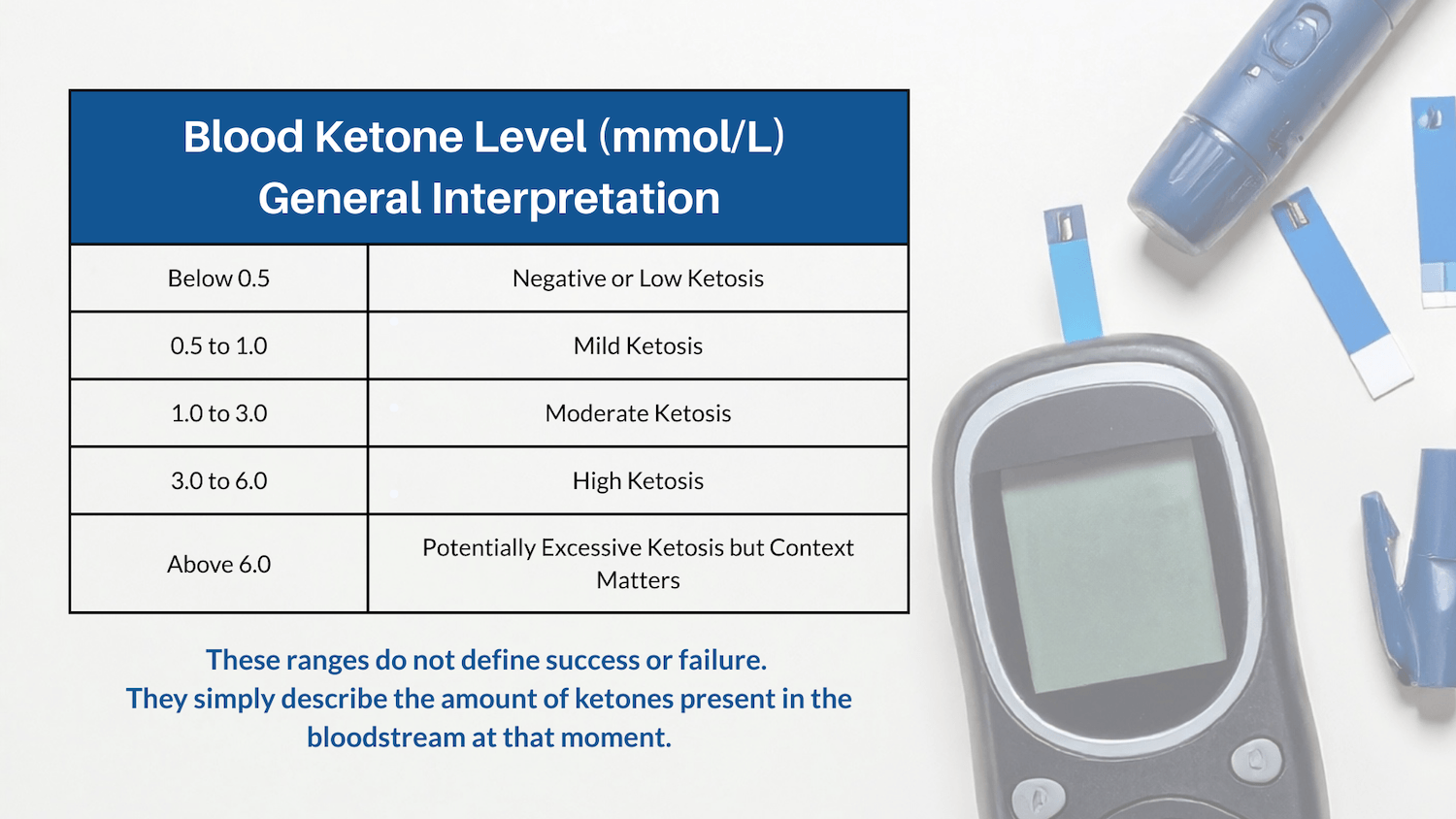
What ketone numbers can tell you
Ketone monitoring can be helpful for understanding patterns and guiding adjustments. It can help answer questions such as:
Is your body producing ketones?
How your body responds to certain foods?
How does illness, stress, or sleep affect your ketones?
What range of ketosis best supports your symptom control and overall goals?
Over weeks and months, trends can provide useful insight into how your body is adapting.
What ketone numbers cannot tell you
This is where misunderstanding often occurs.
A single ketone reading cannot tell you:
Whether the diet is “working”
Whether you are making progress
Whether clinical goals are being met
Whether your approach needs to change
Ketones are just one marker. They do not capture the full picture of clinical response.
Many meaningful outcomes, including improvements in symptoms, cognitive clarity, energy levels, or overall stability, do not always correlate directly with a specific ketone number.
Why trends matter more than individual numbers
One of the most important principles in ketone monitoring is this: trends are more meaningful than individual readings.
A single value is influenced by immediate circumstances. A trend reflects how your ketogenic diet is impacting your metabolism over time.
For example, ketone levels may be lower one morning after poor sleep or higher after a period of fasting. Neither of these isolated readings defines your overall metabolic state.
Looking at patterns across days and weeks provides far more useful information than focusing on any single measurement.
Individual variability is normal
Two people can follow the same ketogenic approach and have different ketone levels while both are responding well.
This variability reflects differences in:
Metabolic efficiency
Degree of adaptation
Hormonal environment
Body composition
Underlying health conditions
Higher ketones do not automatically mean better outcomes. Lower ketones do not automatically mean poor outcomes.
Ketones are a tool, not the goal
Ketone levels are a useful tool, but they are not the ultimate goal. They help us understand whether your body is in ketosis, how consistently the ketogenic diet is being followed, and how aggressive or restrictive the approach may be.
Rather than viewing ketone numbers as something to chase or control, it can be helpful to view them as information that helps guide thoughtful adjustments over time. They may help us determine whether changes to food composition, timing, or overall intake are needed to better support your clinical goals.
At the same time, ketones are only one part of the picture.
What matters most is how you are feeling and how your body is responding overall. In clinical practice, decisions are guided not just by ketone levels, but by symptom control, stability, laboratory markers, energy, cognitive function, and long-term sustainability.
The bottom line
Ketone monitoring can be a valuable tool, but it works best when interpreted in context.
Ketone numbers naturally fluctuate. They vary between individuals. And they do not define progress on their own.
The goal is always to support the best possible clinical outcome, using ketones as one of several tools to guide care.
