
From Intake to Implementation: How Personalized Ketogenic Plans Are Built
Starting a therapeutic ketogenic diet can feel overwhelming—especially for individuals who have tried “keto” before and found it confusing, unsustainable, or ineffective. One of the most common concerns we hear is simple: What actually happens after the introductory call?
At Advanced Ketogenic Therapies (AKT), ketogenic metabolic therapy is not delivered as a generic plan or a fixed set of rules. It is built through a guided, step-by-step process designed around the individual, supported by clinicians, and adjusted over time to support long-term success.
This article walks through how personalized ketogenic plans are developed—from intake through implementation—and what clients and referral partners can expect at each stage of the process.
Why a Structured Process Matters
Therapeutic ketogenic diets are not something most people can safely or effectively piece together on their own. Individual health history, current symptoms, medications, metabolic status, and tolerance all influence how a ketogenic approach should be designed and initiated.
A clear process helps to:
Reduce uncertainty and anxiety
Ensure education happens at the right pace
Support safety during dietary transitions
Create a plan that evolves rather than stalls
Rather than jumping straight into carbohydrate restriction, AKT begins with intentional groundwork so implementation is informed, supported, and sustainable.
Your Personalized Roadmap to Ketogenic Metabolic Therapy
AKT’s process is often described as a roadmap because it provides structure without assuming a single destination. While no two journeys look the same, most follow a similar framework.
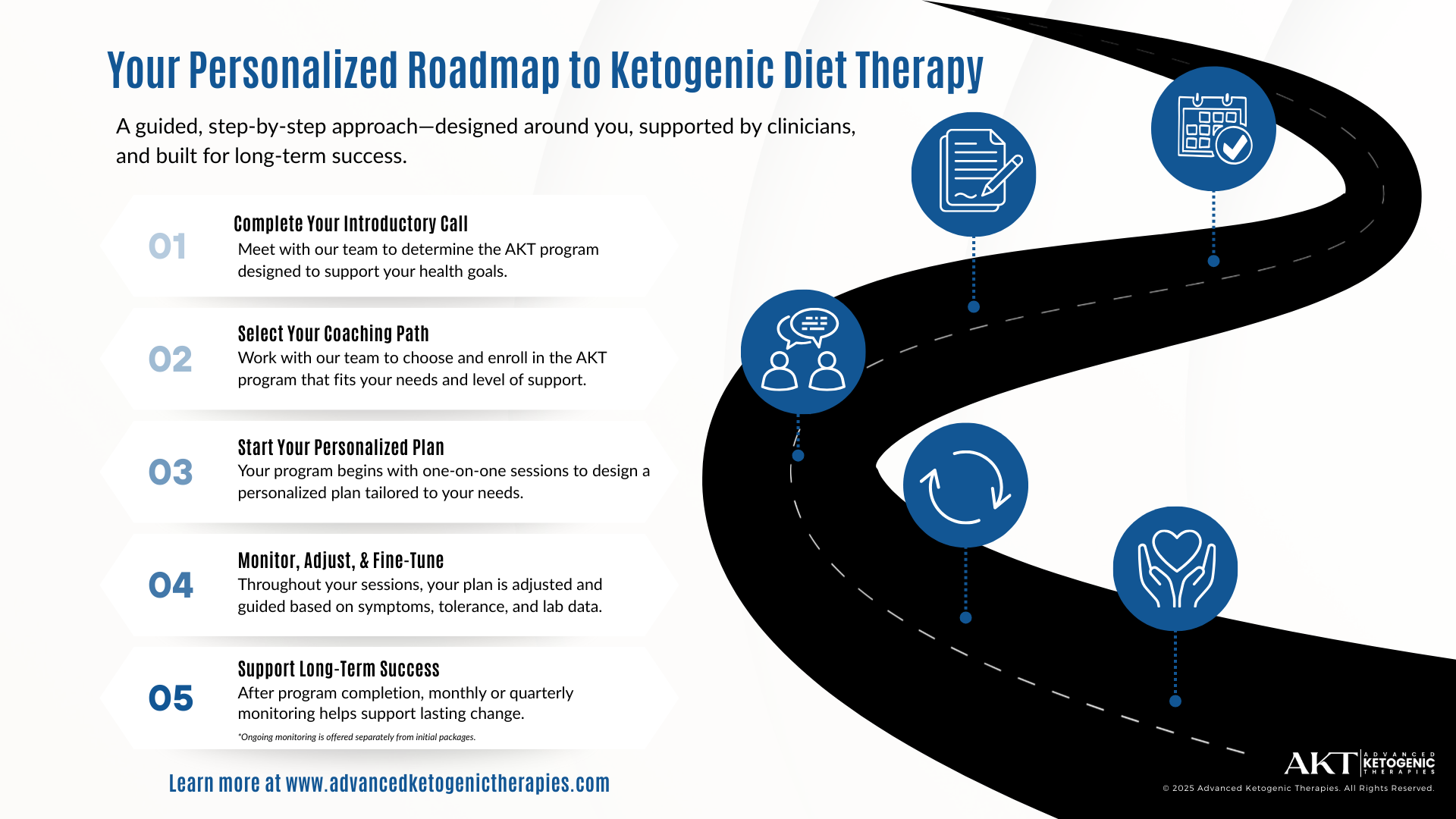
Step 1: Start Your Roadmap With an Introductory Call
The first step is a complimentary introductory call. This conversation is designed to help you understand how AKT works and identify the coaching program that best aligns with your goals and desired level of support.
For prospective clients, this call helps:
Explain our one-on-one, clinician-led coaching model
Walk through program structure and package options
Discuss your goals at a high level and key considerations
Provide clarity around pricing, process, and next steps
Step 2: Select the Right Coaching Path
After the introductory call, individuals work with the AKT team to select and enroll in the program that best aligns with their goals and desired level of support. Programs vary in structure and duration, but all are built around a consistent foundation.
AKT programs emphasize:
Individualized care through one-on-one, clinician-led sessions
Ongoing clinician involvement to support education, implementation, and adjustment
Education and skill-building to promote confidence and long-term success
Clinician-led Q/A sessions, which provide additional group-based support between individual appointments
This step ensures expectations are clear before implementation begins.
Step 3: Build a Personalized Ketogenic Plan
Once enrolled, the program begins with one-on-one sessions focused on designing a personalized ketogenic plan. This includes a detailed intake process that involves:
Comprehensive health history forms
Review of medications and supplements
Baseline food intake assessment
Review of relevant lab work when available
Plans are built around the individual—not a preset ratio or template—and take into account tolerance, lifestyle, and current health status.
Education is introduced gradually and intentionally, often covering topics such as:
The physiology of ketosis
Carbohydrate limits and flexibility
Blood glucose and ketone monitoring
Sick-day and hospital considerations
Medications and carbohydrate exposure
Fluids, electrolytes, and fat sources
Tools for tracking and meal planning
Step 4: Monitor, Adjust, and Fine-Tune
Implementation does not end once ketosis is achieved. Throughout the program, plans are adjusted based on:
Symptoms and functional changes
Tolerance and gastrointestinal response
Glucose and ketone trends
Lab data when applicable
Adjustments are guided by patterns over time and are discussed collaboratively during scheduled sessions.
This phase is where personalization becomes most visible, as plans evolve in response to how the body adapts.
Step 5: Support Long-Term Success
Following program completion, monthly or quarterly monitoring is recommended for most individuals. This ongoing support allows for reinforcement of skills, continued progress tracking, and timely adjustments as goals or circumstances change.
Long-term success is not defined by strict adherence to a single version of keto, but by the ability to apply principles flexibly and confidently over time.
A Real-World Example: What This Process Can Look Like
To show how this works beyond theory, the example below shares a ketogenic journey that reflects what this process can look like day to day.
Blake, a 30-year-old male, enrolled in an AKT program after an introductory call. He had a history of schizoaffective disorder, depression, and auditory hallucinations, was largely housebound, and was dependent on family support. He was taking multiple medications for mental health management and consuming a standard American diet with more than 150 grams of carbohydrate per day.
After enrollment, Blake completed intake forms and baseline lab work. He was matched with an AKT clinician who reviewed his intake, supplements, and a two-day food journal which showed high carbohydrate consumption with relatively low-fat intake.
During early sessions, education was introduced gradually, covering topics such as ketosis, interpreting nutrition labels to identify carbohydrate content, glucose and ketone monitoring practices, and practical preparation. Blake gathered basic supplies and began tracking blood glucose and ketones.
Together, Blake and his clinician initiated a modified ketogenic approach, starting with a gradual, meal-by-meal transition rather than an abrupt shift. Over several weeks, ketogenic meals were introduced incrementally, allowing time for adaptation and monitoring.
Within the first month, Blake reported improvements in mood, energy, and gastrointestinal tolerance, with measurable ketone production and gradual weight changes. Over subsequent months, his plan continued to evolve with a shift towards greater independence with food choices and less reliance on precise weighing as skills and confidence improved.
By nine months, Blake had transitioned to a less restrictive ketogenic pattern, no longer required measured meals, and maintained stable mental health symptoms alongside his existing medical care. He was able to return to work, leave the house independently, and sustain improvements in quality of life.
This outcome was not the result of a single diet rule or ratio, but of a structured, adaptive process supported over time.
What This Process Is—and What It Isn’t
This roadmap is not about perfection, speed, or rigid control. It is about:
Building understanding before restriction
Adjusting based on response rather than assumptions
Supporting autonomy through education and structure
Most importantly, it recognizes that the level of carbohydrate restriction needed for success varies widely and that plans should evolve as individuals do.
Final Thoughts
A personalized ketogenic plan is not built in a single session or delivered as a template. It is developed through a guided process that prioritizes education, individualization, and long-term sustainability.
If you are ready to explore whether this approach is right for you, the next step is a conversation. Scheduling a complimentary introductory call helps clarify goals, outline next steps, and determine the level of support that aligns with your needs. For additional questions, our FAQ section provides more details about what to expect.
