
Artificial Intelligence vs Clinical Care: Why Personalization Still Matters
The Shift We’re Seeing
More people are turning to AI for nutrition guidance. Tools like ChatGPT, Consensus, Gemini, Claude, and Perplexity are becoming part of everyday decision making, and new options seem to appear constantly.
It makes sense. These tools are fast and accessible. You can ask for a 1500 calorie ketogenic plan and instantly get meals, macros, and food ideas. On the surface, it looks complete. It looks like something you could follow.
But what you are getting is a general framework, not something built for you. It is based on patterns and assumptions. It does not know your clinical goals, your history, your labs, or how your body actually responds.
Information vs. Care
AI can generate information. It can create plans, estimate macros, and organize ideas into something that looks structured. But information is not the same as care.
Ketogenic metabolic therapy (KMT) is not just about what you eat. It is about how your body responds, and how that response is interpreted and adjusted over time.
Outputs are static. Outcomes are dynamic. That is where clinical care lives.
To illustrate this, we asked AI to generate a standard 1500 calorie ketogenic meal plan.
Where This AI-Generated Plan Falls Short
At first glance, this meal plan looks reasonable. But for KMT, that is not enough.
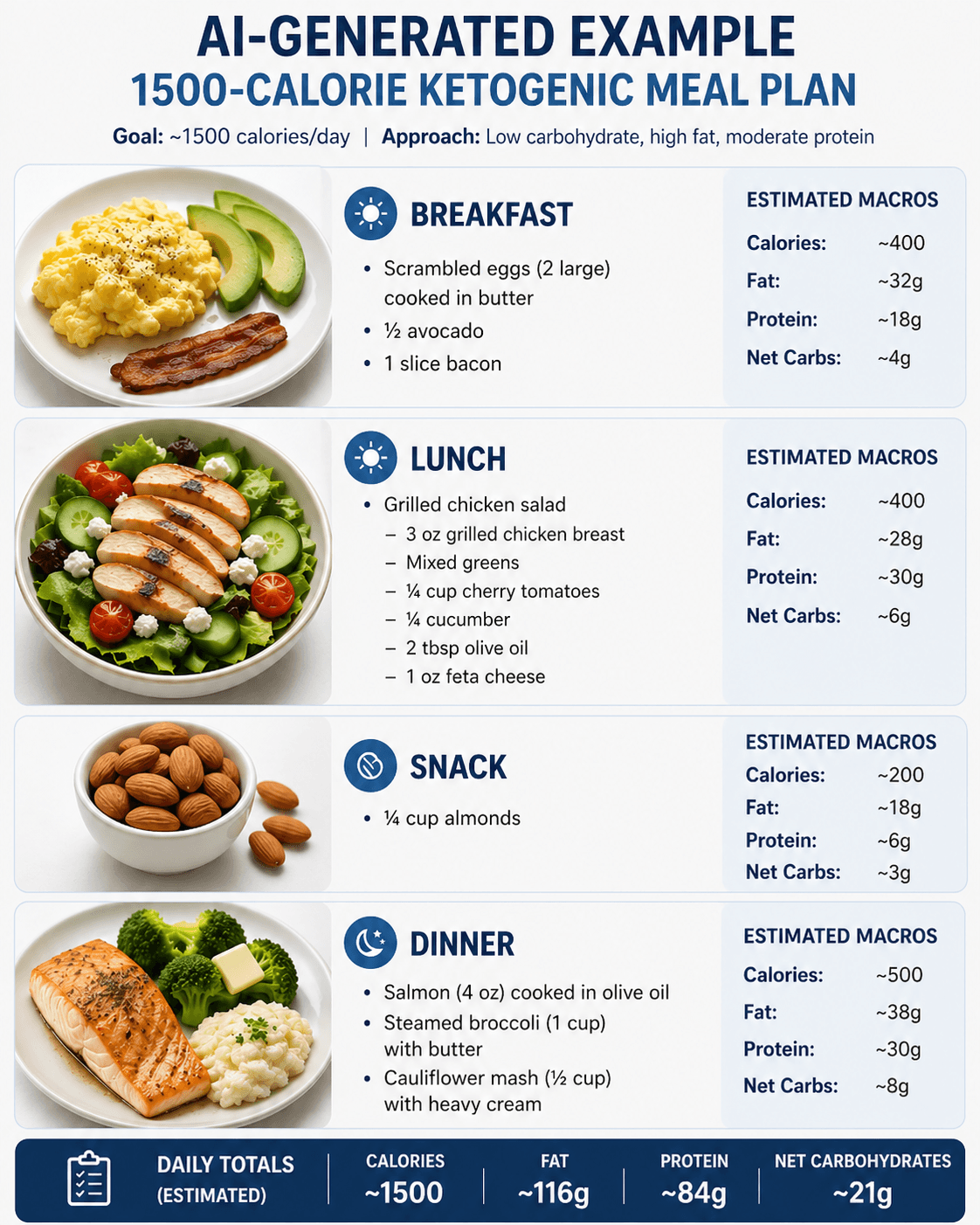
No Consideration of GI Tolerance
This plan includes foods like avocado, almonds, broccoli, cauliflower, and heavy cream. These are all considered keto friendly, but that does not mean they are appropriate for every patient.
Gastrointestinal tolerance varies and directly impacts success. One of the first things we assess is stooling patterns. Are patients constipated, going too frequently, or experiencing changes since starting the diet? Those answers guide food choices.
This also includes broader issues like reflux and delayed gastric emptying. Some foods may worsen bloating or gas, others may be poorly tolerated, and higher fat intake may need to be introduced gradually.
A plan that does not account for tolerance may look appropriate on paper but fail in practice. A food can be keto and still be the wrong choice for a specific person.
No Medication or Medical Context
This plan does not account for medications, which is a critical oversight.
Medications are not separate from the diet. They can contain carbohydrates or affect appetite, GI function, hydration, weight, lipids, and nutrient status.
No Plan for Monitoring or Adjustment
This plan is a one-day snapshot. It provides meals, calories, and macros, but no guidance on what to track or what to do next. There is no plan for monitoring ketones, symptoms, weight trends, or labs, and no direction on how to adjust the diet over time.
In KMT, these are the core of the process. What matters is how the body responds and how that response is translated into action.
AI provides a one-time output. KMT requires ongoing adjustment. A plan is only the starting point. The real work is in how it evolves.
The Goal Is Too Vague
“1500 calories per day with low carbohydrate, high fat, and moderate protein” may look complete, especially with macros included. But it is not a therapeutic prescription.
There is no defined clinical goal, no ketogenic ratio, and no context for how these numbers should change over time. For KMT, we would need to know who this is for, what condition is being treated, age, clinical goals, and whether there are labs, medications, symptoms, or growth concerns.
The clinical context determines the prescription.
AI can only work with the information it is given, and most people do not know the level of detail required to generate an accurate plan. That is not a limitation. It is the reason clinical guidance exists.
Protein May Be Too High
In this plan, protein is set at about 84 grams per day. That may work for some adults, but could be excessive for others depending on body size, clinical indication, and ketosis goals. In KMT, protein is typically dosed based on body weight.
More is not always better. Some patients, especially pediatric patients or smaller adults, may need lower protein to maintain therapeutic ketosis. If protein is too high, ketone levels may drop and outcomes can be affected.
The Plan Does Not Address Micronutrients
This plan does not address vitamins, minerals, supplements, or lab monitoring.
KMT can create or worsen micronutrient deficiencies if not carefully managed. While AI could generate a supplement plan, it would be based on general recommendations, not your labs, intake, or clinical response.
Micronutrient management is an ongoing process of evaluating labs, identifying gaps, and adjusting over time.
A meal plan is not complete just because the macros add up. Nutrient adequacy still matters.
What AKT Does Differently
At AKT, the work does not stop at creating a plan. That is where it begins.
Care is built around the individual, not a template. Calories and ketogenic ratios are prescribed based on clinical goals, body size, and diagnosis, and the plan continues to evolve from there.
Ongoing monitoring is central. We track ketones, symptoms, labs, and day-to-day feedback, then interpret that data to guide next steps.
We consider the full picture, including medications, tolerance, lifestyle, and real-life adherence. When things do not go as expected, we troubleshoot. When ketones drop, we do not just increase fat. We ask why. When a child is hungry, we do not just add calories. We evaluate ketosis, growth, behavior, and what else may be contributing.
But the difference goes beyond clinical interpretation.
AI can generate information, but it cannot provide care. It cannot check in after a stressful week, remember that your child was sick, or help navigate real-life situations like birthdays, travel, school schedules, or unexpected disruptions to routine. It cannot read between the lines, recognize when motivation is fading, or adjust support based on emotions, stress, or day-to-day challenges.
At AKT, that human connection matters. We listen, we remember, and we genuinely care about what is happening outside of the numbers. That relationship allows us to tailor support in a way that adapts to real life, not just ideal conditions.
That is the difference. It is not just about having a plan. It is about knowing how to interpret what is happening, respond appropriately, and support someone through the process in a way that is sustainable long term.
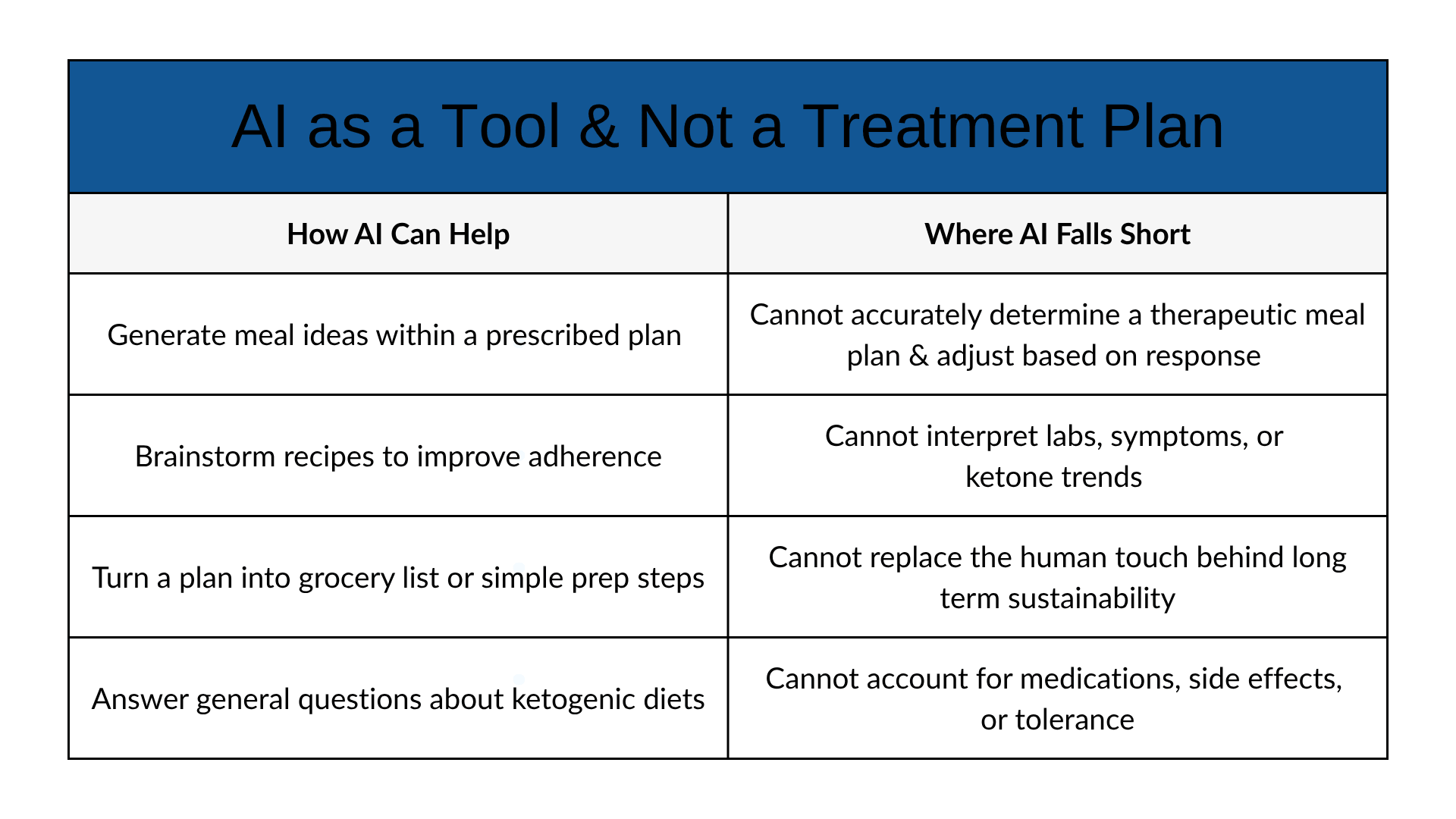
The Bigger Picture: Why This Matters
In KMT, small errors can have real consequences.
A plan that is slightly off may lead to loss of symptom management, impact growth, or contribute to nutrient deficiencies. When the diet doesn’t feel like it’s working, frustration builds and people often stop.
This is why precision and guidance matter. The goal is not just to follow a ketogenic diet, but to use it safely, effectively, and sustainably over time.
AI can be a helpful tool for learning and organization, but it cannot replace clinical judgment, experience, or human interpretation.
KMT is not a template to follow. It is a process that requires guidance.
